
I get asked this more than almost any other question, and it usually arrives in a slightly different shape: do we have to build all the meeting structure before anyone is allowed to improve anything? Underneath it is a reasonable worry. Leaders have watched enough transformations turn into a wall of new meetings that produce nothing, and they don't want to spend six months installing management theater before the first real problem gets solved.
So here is the answer I'd give standing on your floor, and then the reasoning behind it.
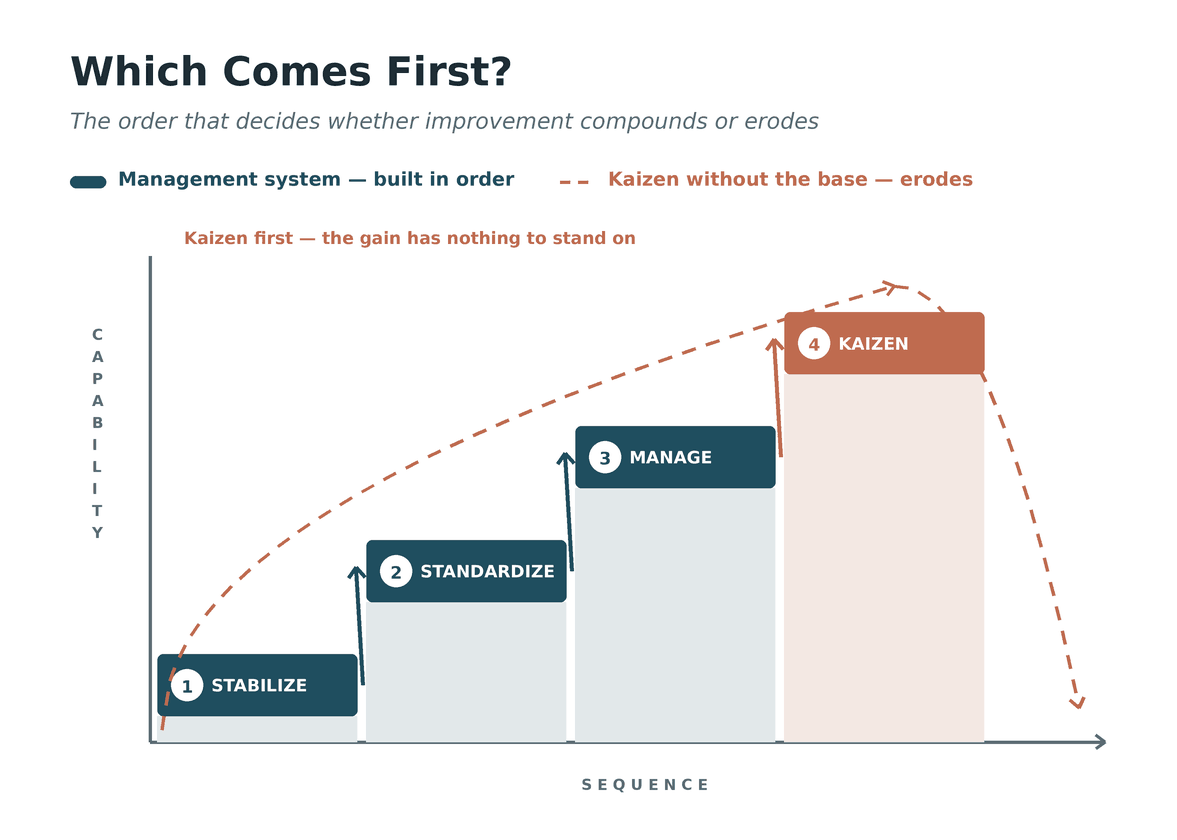
The management system goes first. Not because kaizen matters less, but because kaizen is not a thing you place next to a management system. Kaizen is what a management system produces. Asking which one comes first is a little like asking whether you install the engine or the driving.
Why almost everyone starts with events anyway.
Events win the argument early because they are visible. Five days, a cross-functional team, a cell torn apart and put back together, a number that moves. You get before-and-after photos and a savings figure you can put on a slide for the board. It looks exactly like progress is supposed to look.
And the results are real. Concentrate good people on one problem for a week and you will move the metric. That's not the failure.
The failure shows up around month six. The changeover creeps back toward the old time. The tape on the floor starts peeling. Nobody has updated the chart since the event closed. The improvement didn't collapse dramatically — it quietly un-happened, because the only thing holding the new standard in place was whatever management system was already there. If that system was weak, entropy wins. Not through laziness or resistance. Through the ordinary fact that nobody's actual job was to hold the gain.
I have walked into plants with three years of kaizen binders on a shelf and a floor that looks like year one. The capability was clearly there. What was missing was the thing that carries capability forward on an ordinary Tuesday.
The smallest management system that works.
Here's the part that surprises people: you do not need the full architecture before you begin. You don't need tiered meetings across four levels, a complete leader Standardized Work rollout, and a wall of boards before anyone touches a process. That's how these efforts die of their own weight.
What you need is the minimum that answers three questions on the floor, every day, out loud:
What was supposed to happen? If nobody can state the expected condition — this many units, this cycle, this quality — then nothing that follows is possible. There is no such thing as a problem without an expectation.
What actually happened? Observed, at the place the work occurs, close enough in time that people still remember. Not a number that arrives in a report nine days later, sanded smooth by three layers of summary.
Who closes the gap, and by when? A name and a date. Not a committee, not "operations." The person closest to the work, with a leader whose job is to coach them through it rather than take it over.
That's the seed. Three questions, asked at the gemba, daily, with someone accountable for the answer. Everything else in a mature daily management system is elaboration on those three.
The honest counterargument.
There's a fair objection to everything above, and it deserves a straight answer: you cannot build a management system in the abstract. A daily accountability process with nothing real to be accountable about is just a meeting. People can smell it immediately, and once they've decided the new system is ceremony, you don't get a second first impression.
So yes — you improve early, and you improve visibly. The distinction is what the early improvements are for. Run them as teaching vehicles, not as the deliverable. The point of the first cell you fix is not the savings. It's that a supervisor learns to see waste standing in one place for ten minutes, that a team leader experiences what it feels like to have a problem coached rather than escalated, and that the organization gets one concrete standard worth defending tomorrow morning.
Use the first improvements to build the system. Don't accept them instead of one.
And none of it works on an unstable process.
This is the caveat that matters more than the rest, and it's where I'd start with most plants that call us.
If your 4M's are swinging — if manpower changes shift to shift, if a machine goes down twice a day, if incoming material quality is a coin flip, if the method lives in six people's heads and differs in each one — then you are not improving anything. You are reacting. Improvement requires a baseline, and a process that produces a different result every time it runs does not have one. You will "solve" the same problem four times and never notice, because the noise is larger than the signal you're chasing.
Stability first. Then Standardized Work, which is the part almost everyone treats as paperwork and which is actually the whole foundation: the current best-known method, written down, followed, and therefore improvable. Ohno said it about as plainly as it can be said — where there is no standard, there can be no kaizen. A standard is not a cage. It's the reference line that makes a change measurable instead of merely different.
So what's the actual sequence?
Stabilize the process enough that it produces a repeatable result. Write down the standard so there is something to improve against. Install the daily management that checks plan against actual and puts a name on every gap. And then improve continuously, against that standard, at the gemba, with the people who do the work.
Notice what happens at the end of that sequence. Kaizen stops being an event you schedule twice a year and becomes the ordinary output of a floor where problems surface within hours, get owned locally, and get closed by the person nearest to them. The events become almost unnecessary — not because improvement stopped, but because it's now simply how the place runs.
There is a second half to this, and it is the one most plants never install: the standard exists to be attacked. Conformity holds the gain; resistance produces the next one.
That's the difference between a sawtooth and a staircase. Both go up. Only one of them is still up eighteen months after the consultant's badge is deactivated.
If the wall of faded A3s sounds like your plant.
None of what you achieved in those events was wasted. The proof of capability is right there on the wall. What's missing is the managerial operating system that holds an improvement in place and generates the next one without a signal from outside.
That's the work we care about most — not parachuting in to run another event, but developing your leaders and your daily management so the gains stay yours. If you want to see what this looks like when it's already working, the manufacturers who broke the cycle were rarely the ones who ran the most events. They were the ones who accepted that operational excellence is a way of managing, then did the patient work of learning it.
More output from your floor — and a team that keeps finding it after we've left.
Fourtre Consulting has helped manufacturers install the authentic Toyota Production System since 2007 — the management system, not just the tools. If you're weighing where to start, let's walk your floor together.