
There's a wall in a lot of factories that tells the whole story. It's covered in framed A3s and faded before-and-after photos — the trophies from a decade of kaizen events. Cell redesigned. Changeover cut from forty minutes to twelve. Scrap halved on the number-three line. Real wins, every one of them, celebrated with pizza on a Friday.
Walk that same floor eighteen months later and a strange thing has happened. The changeover is back to half an hour. The 5S tape is peeling. Nobody's updated the number-three scrap chart since the consultant left. The improvements didn't fail, exactly. They just quietly un-happened.
When a plant in this situation calls us, they almost always ask for the same thing: another event. A fresh burst of energy, a new target, another week of intensity to get the numbers moving again. And more often than not, our honest answer is that they don't need another kaizen event at all. They need to learn how to manage.
The event is not the system.
Here's the uncomfortable truth about the kaizen event as most companies run it: it is a tool for making a step-change, and it is very good at that. Concentrate a cross-functional team on one problem for five days and you will move the number. But a step-change is an event, and an event is, by definition, temporary. The moment the team disperses and everyone returns to their day jobs, the only thing holding the new standard in place is whatever management system was already there.
If that system is weak — if supervisors spend their day expediting, if the standard lives in a binder nobody opens, if problems are escalated instead of solved where they occur — then the process does what all processes do without active maintenance. It drifts back toward the old normal. Not because people are lazy or resistant, but because entropy is real and nobody's job was actually to hold the gain.
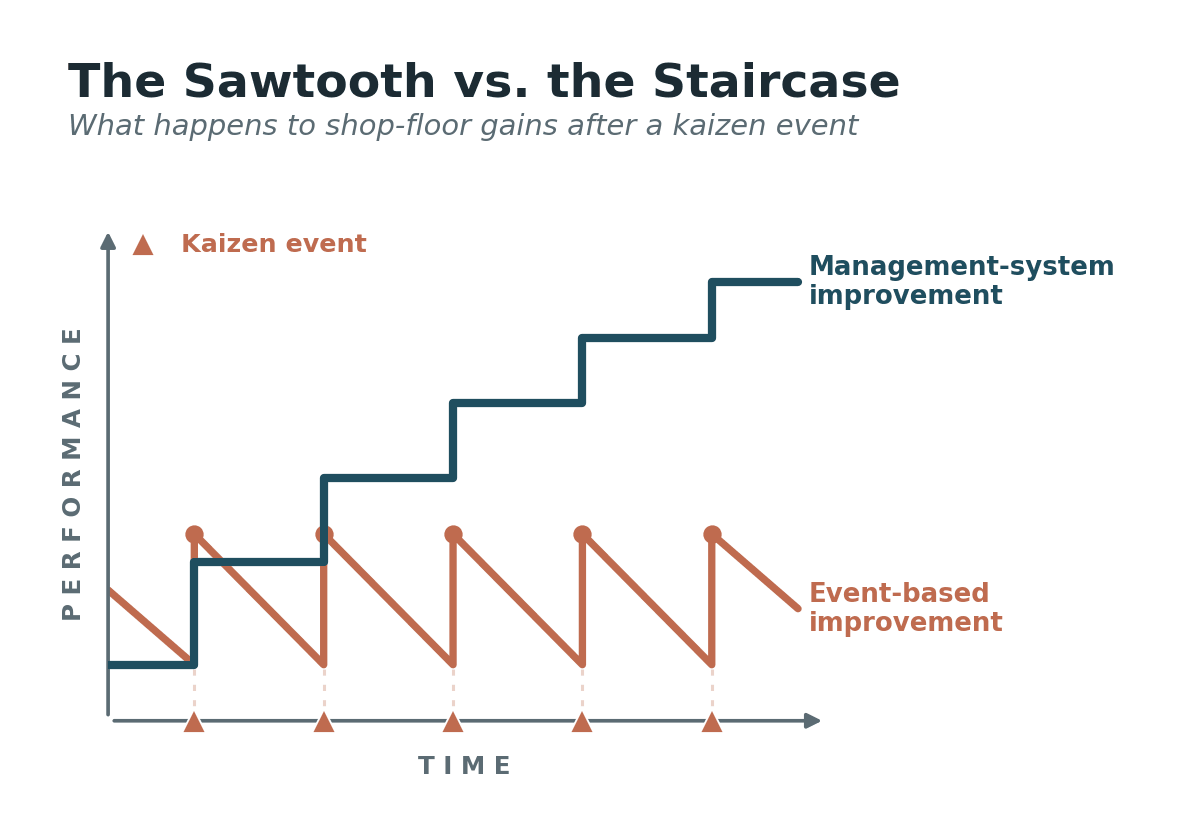
This is the pattern we see over and over: a sawtooth. Improve, decay, improve, decay. Each event lifts the line and each interval erodes it, and the plant spends a fortune in consulting fees and internal energy essentially running in place. Leaders conclude that Lean doesn't stick here, when the real problem is that Lean tools were installed on top of a management system that couldn't carry them.
The 90% everyone skips.
It's worth remembering what the Toyota Production System really is, because the popular version has been sanded down to a toolbox — 5S, kanban, value-stream maps, a calendar full of events. Those are the visible ten percent. The ninety percent that makes Toyota Toyota is not a set of tools. It's a management system, built on two pillars: continuous improvement and respect for people.
Strip away the jargon and it comes down to a set of managerial habits that most Western plants never install. Leaders have standardized work of their own — not just operators. Supervisors go to the floor to see the actual condition, every day, rather than manage from a conference room and a dashboard. There are short, tiered check-ins where abnormalities surface within hours instead of weeks. And critically, when a problem appears, the manager's job is not to solve it and move on — it's to coach the person closest to the work to solve it, and to make sure the countermeasure holds.
In that world, kaizen isn't an event you schedule twice a year. It's the natural output of a floor where problems are seen quickly, owned locally, and improved continuously. The events become almost unnecessary, because improvement is simply how the place runs on a Tuesday.
Learning to manage is the whole game.
When we tell a client the answer is management, not another event, it can land as a letdown. Events are exciting. Management is unglamorous. It's a plant manager learning to spend the first ninety minutes of the day at the boards and on the floor instead of in email. It's a shift supervisor learning to ask “what does the standard say, and what did you observe?” instead of jumping in to firefight. It's a leadership team learning to treat a missed target as a problem to be understood rather than a person to be blamed.
None of that fits in a five-day burst. It's built over months, at the gemba, through coaching — the same way Toyota develops its own leaders. But it is the only thing that converts a sawtooth into a staircase: gains that hold, and then compound, because the system that produced them is still running long after any outsider has gone home.
The manufacturers who break the cycle are rarely the ones who ran the most events. They're the ones who accepted that operational excellence is a way of managing, not a project you complete — and then did the patient work of learning it.
Nothing you achieved was wasted.
If the wall of faded A3s sounds like your plant, the good news is that nothing you achieved in those events was wasted. The capability to improve is clearly there. What's missing is the managerial operating system that holds improvements in place and generates the next one without a signal from outside.
That's the work we care about most: not parachuting in to run another event, but developing your leaders and your daily management so the gains stay yours. More output from your floor — and a team that can keep finding it after we've left.
If you're weighing where to start, the companion piece to this one goes into the sequence in detail: which comes first — the management system or kaizen?
Fourtre Consulting has helped manufacturers install the authentic Toyota Production System since 2007 — the management system, not just the tools. If improvements keep leaking away at your plant, let's take a look together.